
Home / Treatments / Crown Hair Transplant

Our treatment

Crown Hair Transplant

Hair Transplant Scar Repair

Scars on your scalp can stem from all sorts of reasons, from accidents to past hair transplants. Hair restoration can effectively conceal scars, providing a natural and seamless appearance.

Why can’t hair grow through scar tissue?

Scar tissue is the body’s natural response to injury or surgery. It’s a dense layer, primarily composed of collagen, to shield the underlying skin.

Unfortunately, this thick skin leaves little room for hair follicles to emerge. Plus, scar tissue tends to have reduced blood flow, depriving follicles of essential oxygen and nutrients needed for growth. 

Can I have a hair transplant on scar tissue?

Transplanting hair onto scar tissue can be trickier than on regular skin because of the reduced blood flow. However, it is possible. 
The success of a hair transplant for this usually depends on the health of the skin behind the scar. If the blood supply is limited, the newly transplanted hairs may not grow as expected.

What is a hair transplant for scar repair?

Hair restoration for a scar entails harvesting healthy hair follicles, typically from the sides of your head, and transplanting them to the affected area—whether it’s a scar on your scalp, beard, or even your eyebrow.The goal is for the transplanted hairs to grow naturally and seamlessly, blending in with the rest of your hair to conceal the scar.

There are two main methods of transplantation: Follicular Unit Transfer (FUT) and Follicular Unit Extraction (FUE).

When addressing scar tissue, FUE is often favoured as it typically results in less noticeable scarring. In contrast, FUT leaves a small linear scar on the back of your head. However, if you have substantial scarring, like that caused by burns, FUT may be more suitable. FUT provides a greater number of follicles to cover the area.

The primary distinction lies in the method: FUT requires removing a strip of scalp from the donor area, leaving a small linear scar but providing more grafts. In contrast, FUE removes follicles from the scalp with tiny punches, leading to less scarring and quicker recovery. FUT suits larger areas, FUE for minimal scars.

Who is the right candidate for hair scar repair?

To determine if you’re the right candidate for hair transplantation for scar repair, a surgeon will assess various factors, including:

If the scar is too thick (hypertrophic), blood flow will be limited, hindering transplanted hair growth. On the other hand, overly thin scars may struggle to hold transplanted follicles securely, resulting in low or patchy coverage.

 Inflammatory diseases, like lupus, can disrupt the normal function of hair. This can lead to weakened or damaged follicles, affecting their ability to support new hair growth after transplantation. It’s recommended to wait for at least five years of disease inactivity before considering a transplant.

Understanding what you hope to achieve and discussing realistic outcomes with your surgeon ensures that your expectations align with the potential results of the transplant.

The amount and quality of your donor hair will determine if there’s enough to get great results and cover up the scarred area nicely.

To learn more, read our guide on the best candidate for FUE hair transplants. 

“World of difference to my confidence”

Peter

The hair transplant scar repair process

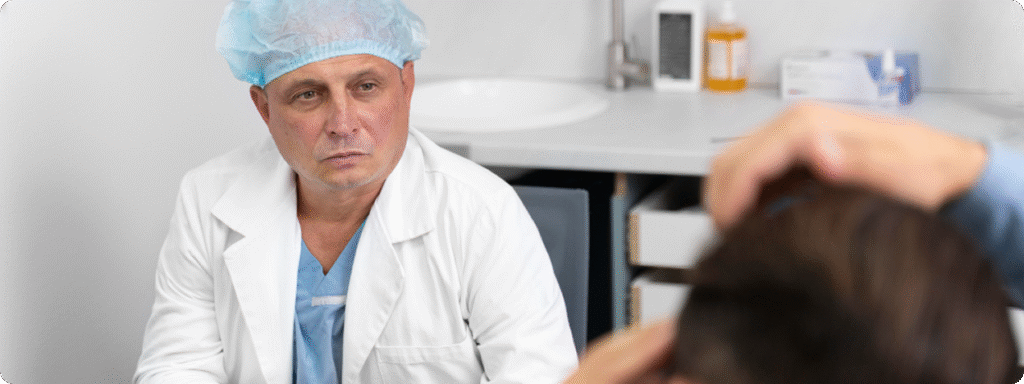
The restoration process begins with a consultation to evaluate your current hair condition. During this session, the surgeon will assess whether you’re suitable for a hair transplant and offer advice on the subsequent steps.

Your surgeon will consider various factors, including:

Understanding what to expect on the day of your hair transplant can help alleviate any concerns. Although every surgery is customised to meet your individual requirements, here’s a general overview of what you can expect during the procedure:

On the day of the surgery, you will be administered either local anaesthesia with sedation or general anaesthesia to ensure your comfort throughout the procedure.

Healthy hair follicles are carefully extracted from the donor area using the FUE or FUT method. In the case of the FUT technique, the surgeon will subsequently close and stitch the incision for proper healing.

After extraction, the grafts are sorted into groups based on their thickness and size. This categorisation is essential to ensure that the transplanted hair matches your desired crown area’s shape and density.

With skill and precision, each follicle is strategically placed in the crown area, following the designed plan to achieve a natural result.

The whole procedure usually lasts between 3 to 8 hours, but it can vary from person to person. Remember, you won’t see the final results until your scalp has completely healed, which usually takes about 12 months.

Hair transplant scar recovery and aftercare

Hair transplants on scar tissue can be challenging due to reduced blood flow. That’s why attending your scheduled check-ups is essential. Your surgeon needs to monitor the area closely to ensure the transplanted follicles are taking hold properly. If you have any worries, don’t hesitate to contact your surgeon for guidance.

Things to avoid after surgery include: 

After the procedure, your surgeon will supply you with pain relief medication to ensure your comfort during the first few days of recovery. They’ll also give you all the hair transplant aftercare instructions you need. 

What are the alternatives to DHI hair transplants?

Direct hair transplants can be more expensive and time-consuming than other restoration methods. However, there are alternatives available. These well-established methods have a track record of proven success.

FUT (Follicular Unit Transfer)

This method involves carefully removing a thin strip of skin from the back of the head. Hair follicles are then taken directly from it and carefully planted into the crown area. You’ll be left with a thin linear scar on the back of your head, but it will generally only be visible if you have very short hair.

FUE (Follicular Unit Extraction)

Using a precise instrument called a micro punch, hair follicles are extracted from the donor area, usually around the back and sides of the head. These healthy follicles are then placed into small incisions on the crown area. This is known for being a painless procedure, yielding precise results with minimal scarring.

Hair transplant FAQs

“Dr. Muhammad put me at ease and made me feel truly comfortable. The entire process was much easier than I expected, and my results are fantastic.”

PRECISION HAIR Direct hair implantation

It’s our advanced follicular extraction technique, where individual grafts are removed and implanted directly by the surgeon using fine forceps, without the need for pre-made incisions. It works for most types of hair loss and is known for natural-looking, high-density results with minimal downtime.

PRECISION HAIR is a minimally invasive technique, so rather than a single linear scar, you’re left with tiny, evenly spread puncture marks in the donor area that fade significantly and are easily concealed even with short hair. Your surgeon will talk you through what to expect for your specific case at consultation.

The area is fully numbed with local anaesthetic before we begin, so most patients feel little to no pain during the procedure itself, just some pressure or tugging. Mild soreness or tightness in the days after is normal and easily managed with the aftercare medication we provide.

Yes, we’ll send you home with a short course of medication, such as pain relief and antibiotics, to support healing and reduce the risk of infection. Some patients are also prescribed ongoing treatments like minoxidil or finasteride to help protect existing hair and support long-term results.

This depends on factors like your degree of hair loss, donor hair availability, and desired outcome. During your consultation, one of our surgeons will assess your scalp and goals in person and recommend whether PRECISION HAIR, FUT, or another approach is the right fit for you.

Transplanted hair typically sheds within the first few weeks, which is a normal part of the process, before new growth begins around month three to four. Most patients see noticeable thickening by month six, with full, final results visible at around twelve months.

TrustScore: 4.6/5

Michael Turner

Really pleased with how it was handled from start to finish. The consultation was thorough with no pressure at all, and the team talked me through every step so I knew what to expect on the day. Aftercare calls were a nice touch too, checking in during the first week.

Oliver Bennett

Good experience overall from a friendly, easy to find clinic. The procedure went smoothly with regular breaks throughout. Only reason it’s not five stars is the wait to get booked in ran a little long, but once in, everything moved like clockwork and healing is coming along nicely.

Daniel Whitfield

Can’t fault the service, honestly. Was nervous going in but the team put me at ease straight away and explained everything clearly, patiently answering every question I had. Results are already looking promising a few months on, glad I went with them rather than shopping on price alone.

Contact Us Today

This is a great opportunity to discover your hair restoration options. Simply fill in the form below to arrange an appointment.